


 Cart
Cart
 sales@molnova.com



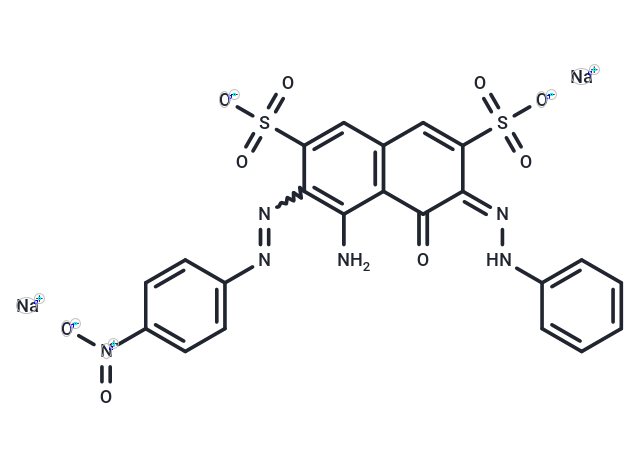
Amido Black 10B
CAS No. 1064-48-8
Amido Black 10B( —— )
Catalog No. M35834 CAS No. 1064-48-8
Amido Black 10B (Naphthol Blue Black) is a highly toxic azo dye used for staining proteins on polyacrylamide gels and agarose gels.
Purity : >98% (HPLC)
 COA
Datasheet
HNMR
HPLC
MSDS
Handing Instructions
COA
Datasheet
HNMR
HPLC
MSDS
Handing Instructions
| Size | Price / USD | Stock | Quantity |
| 1G | 26 | In Stock |


|
Biological Information
-
Product NameAmido Black 10B
-
NoteResearch use only, not for human use.
-
Brief DescriptionAmido Black 10B (Naphthol Blue Black) is a highly toxic azo dye used for staining proteins on polyacrylamide gels and agarose gels.
-
DescriptionAmido Black 10B (Naphthol Blue Black) is a highly toxic azo dye for amino acid staining. Amido Black 10B can create several problems in the human respiratory system and may also cause skin and eye irritations.
-
In Vitro——
-
In Vivo——
-
Synonyms——
-
PathwayOthers
-
TargetOther Targets
-
RecptorOthers
-
Research Area——
-
Indication——
Chemical Information
-
CAS Number1064-48-8
-
Formula Weight616.49
-
Molecular FormulaC22H14N6Na2O9S2
-
Purity>98% (HPLC)
-
Solubility——
-
SMILESO=[N+]([O-])C1=CC=C(C=C1)N=NC2=C(S(=O)([O-])=O)C=C3C=C(S(=O)([O-])=O)C(N=NC4=CC=CC=C4)=C(O)C3=C2N.[Na+].[Na+]
-
Chemical Name——
Shipping & Storage Information
-
Storage(-20℃)
-
ShippingWith Ice Pack
-
Stability≥ 2 years
Reference
1. Angelova R, et al. Magnetically modified sheaths of Leptothrix sp. as an adsorbent for Amido black 10B removal. Journal of Magnetism and Magnetic Materials, 2017, 427: 314-319.
molnova catalog



related products
-
TAT (48-57) TFA
TAT (48-57) (TFA) is a cellular permeability peptide derived from hiv-1 transcriptional activator (TAT) protein residue 48-57.
-
Chicanine
Chicanine has anti-inflammatory activity in macrophages by down-regulating LPS-induced inflammatory cytokines in IκBα±/MAPK/ERK signaling pathways.
-
ACTH 11-24
ACTH (11-24) is a fragment of adrenocorticotrophin, induces cortisol release. ACTH (11-24) has been identified as a competitive antagonist of ACTH (1-39) and ACTH (1-10) in isolated adrenal cells.
